Every line is a live link inside the product. Tap any tool to see what it means for your team.
For independent hotels · built by a hotel operator
The whole hotel, on the same page.
Angel Hub is one connected app that runs your whole operation — tasks, chat, call-outs, rooms, safety, budgets. Everything is linked, so everyone knows what’s happening, handovers explain themselves, and nothing gets lost in a group chat.
- Works on any phone
- No per-user fees
- Engineers & guests need no accounts
Sound familiar?
Most hotels run on one of two systems. Both hurt.
47 messages about one leak — and still no owner.
Jobs live in group chats and on paper. Things get missed, nothing has an owner, and when the EHO or an insurer asks for history, there isn’t any. Managers find out about problems late — and staff carry the stress home.
It costs £0 in software, and a fortune in everything else.
Four logins, four bills, and none of them talk.
One tool for maintenance, one for compliance, one for training, plus the group chat. Each one is bought separately, billed separately and logged into separately — and you are still the one carrying information between them.
The tools are fine. The gaps between them are where things get lost.
Angel Hub replaces both: the whole operation in one connected system, from £149 per hotel per month + VAT.
A day with Angel Hub
Nobody chases anything. Everybody knows.
This is the point of the whole product: information moves by itself, so your team can look after guests instead of chasing updates.
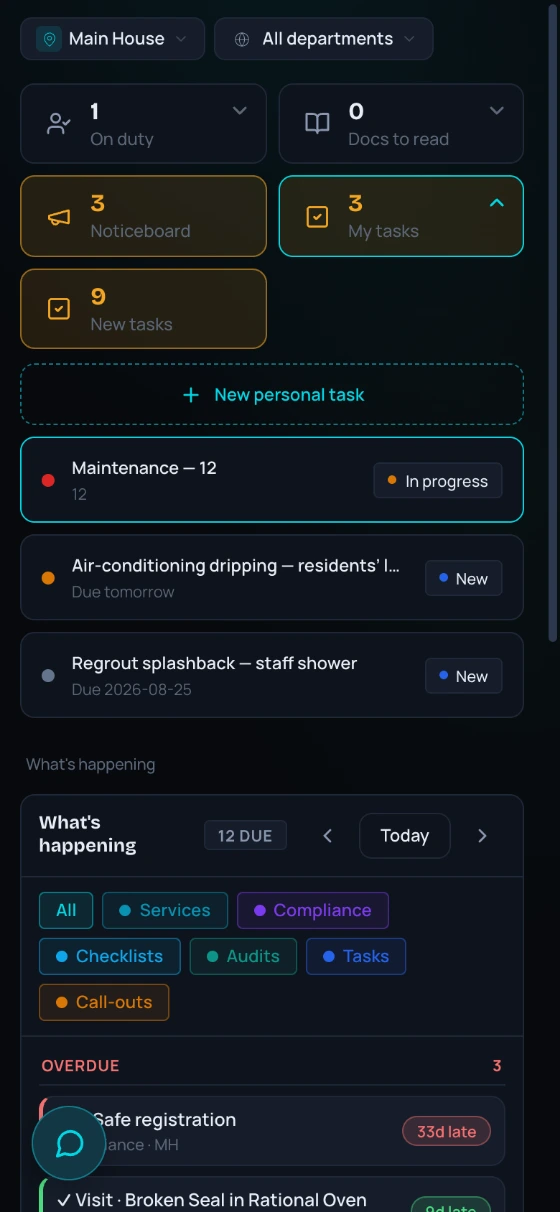
Walk in, open one screen, know your day.
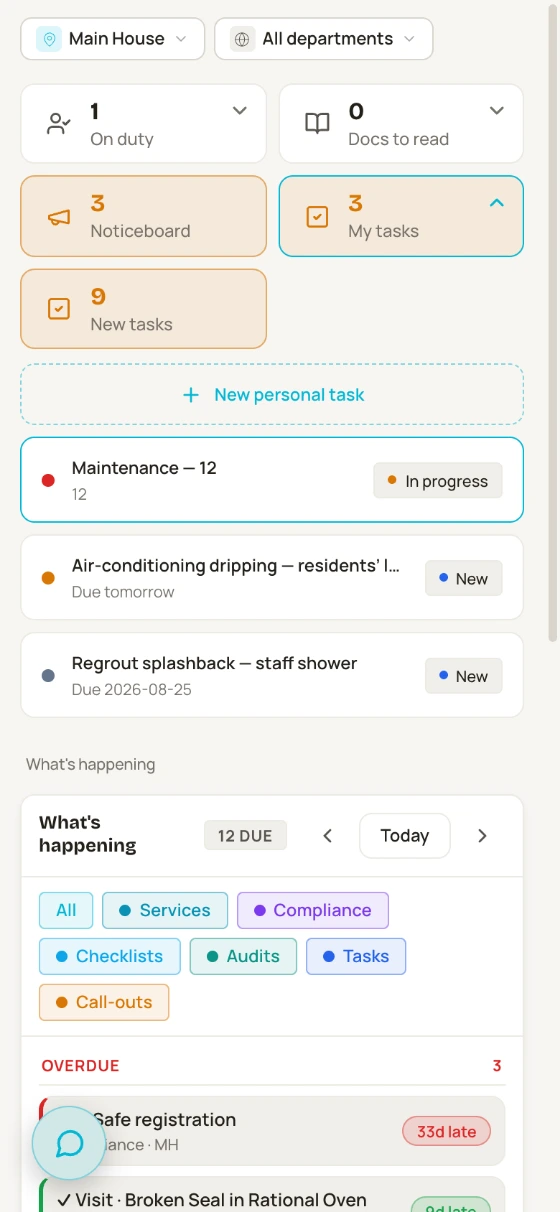
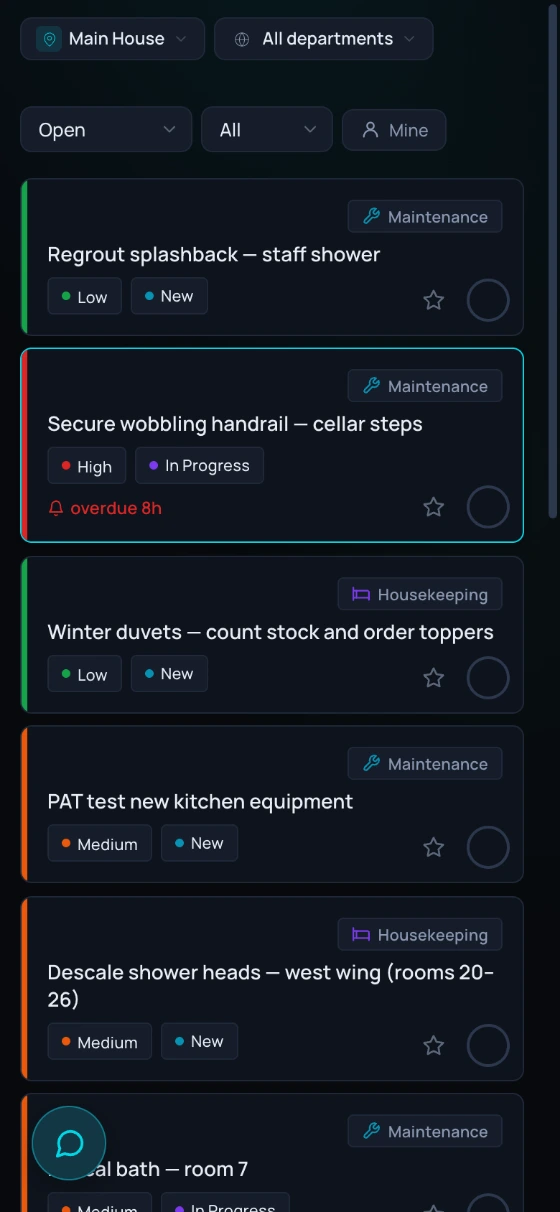
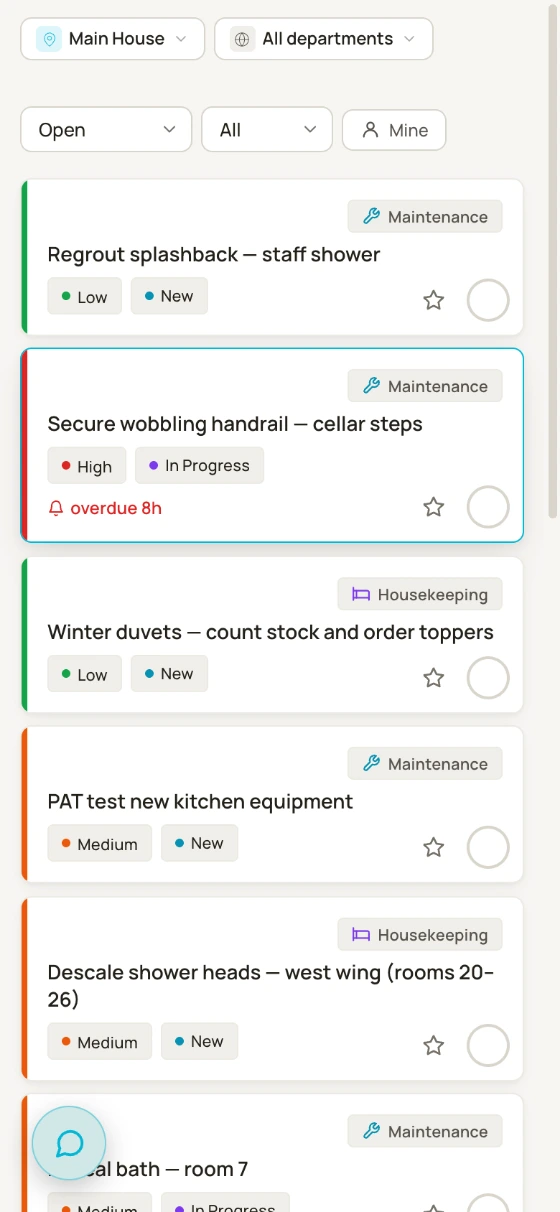
Everything outstanding is on the dashboard — no digging. Your own tasks sit at the top, urgent first, overdue flagged, clearly yours rather than the whole team’s. Below them, a calendar of everything the site owes:
- Tasks
- Call-outs
- Checklists
- Audits
- Services due
- Compliance renewals
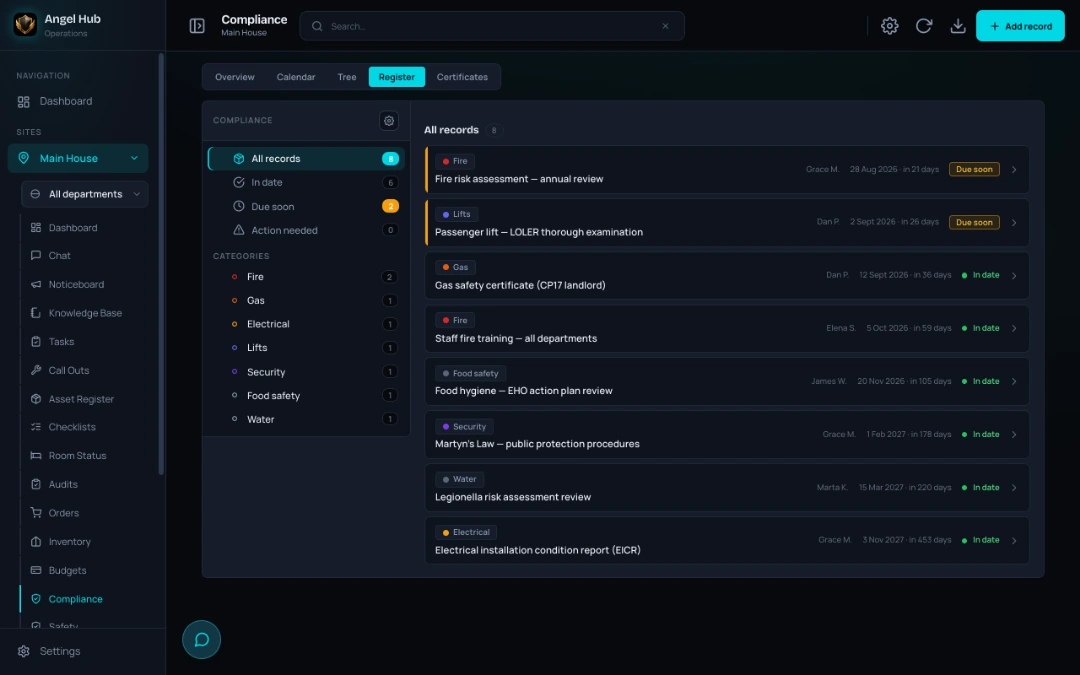
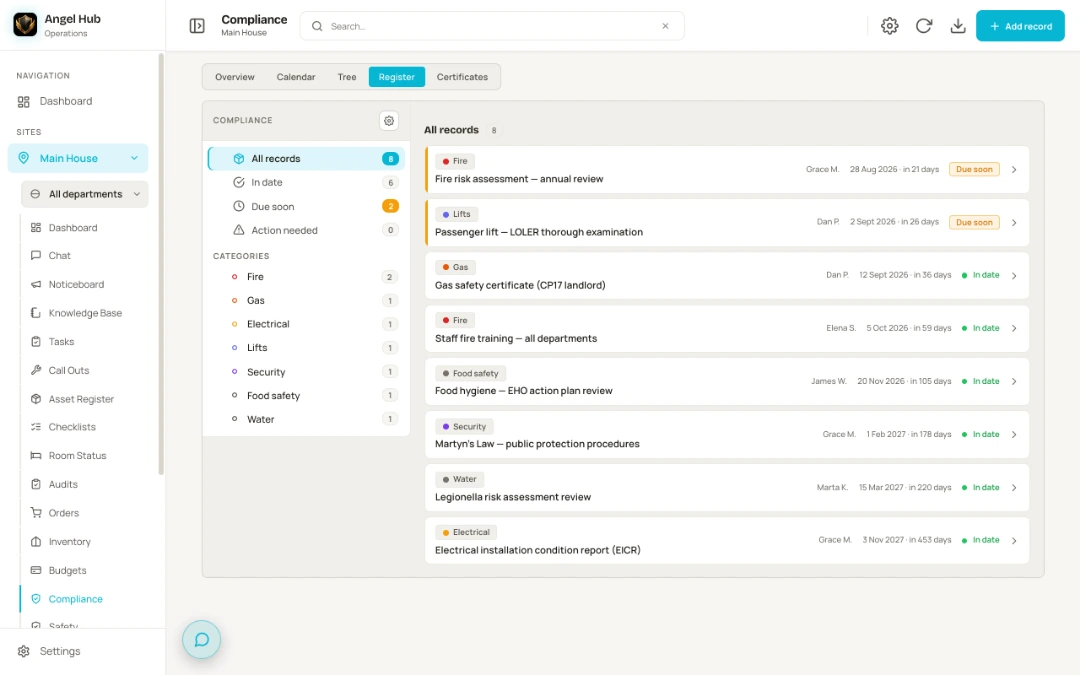
Compliance is the one that bites — fire and legionella risk assessments, the food hygiene rating, Martyn’s Law, staff fire training — each with a date, an owner and a countdown. Who’s on duty is right there too, and anything waiting on you — a safety document to read, training that’s run out, a notice posted since you last looked — is a tile you can’t walk past.
No catching up in the car park. No scrolling through last night’s messages. Ops directors see every department and every site from the same place.
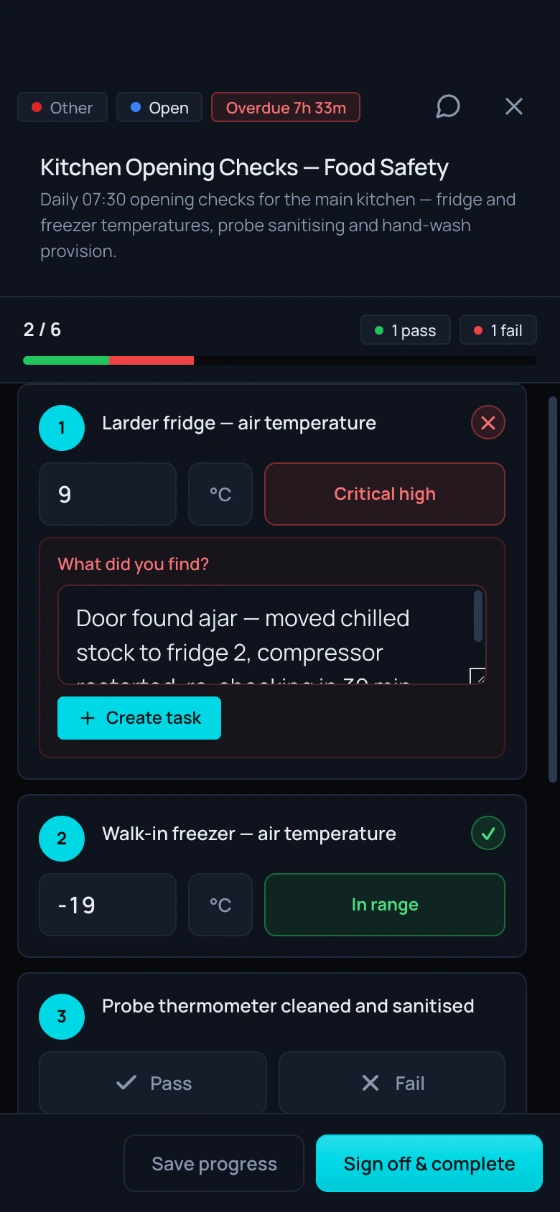
The fridge reads 9°C. One tap later, maintenance has the job.
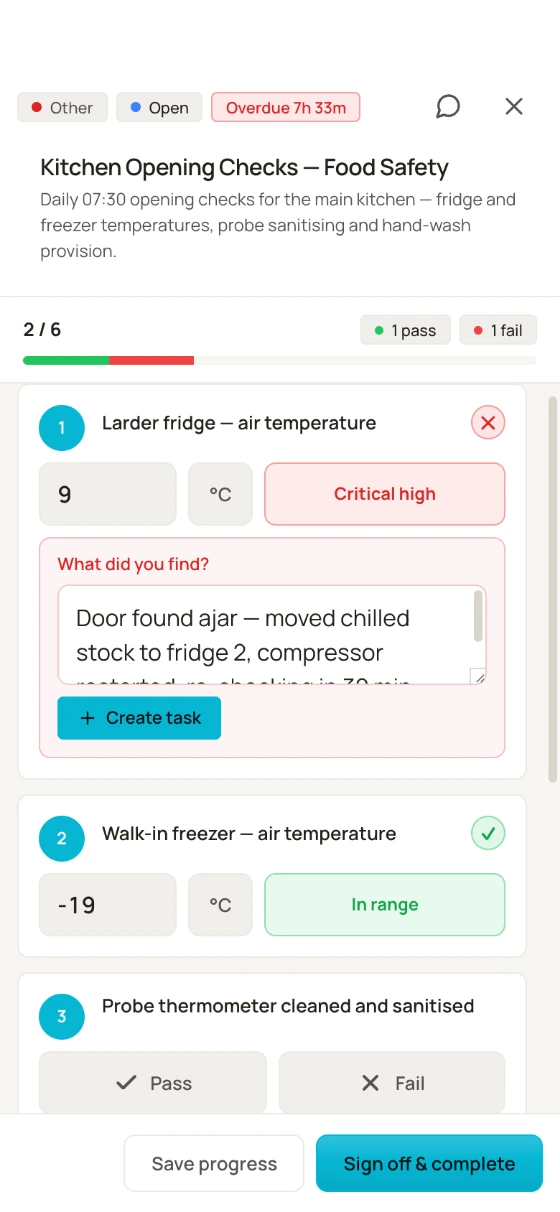
Morning checks run from a phone, and every check can carry photos and instructions — so a new starter runs them properly in their first week without pulling anyone off breakfast. When something’s wrong, one tap raises a ready-made task: what was found, where, and the team that should fix it, already filled in. Zero retyping, zero “I’ll mention it later”.
Temperature checks take a number, not a tick. You set the safe range for every fridge, freezer and pool reading — the entry turns green, amber or red as it’s typed, and an out-of-range reading can raise that ready-made task on the spot. For a pool plant room or a busy kitchen, reaction time is everything.
Every signed-off reading builds a month-by-month history — fridge by fridge, pool by pool — with each reading and its follow-up task linked for good. When the EHO asks how you know the fridges are safe, you export it.
A leak in room 12 becomes a job in seconds.
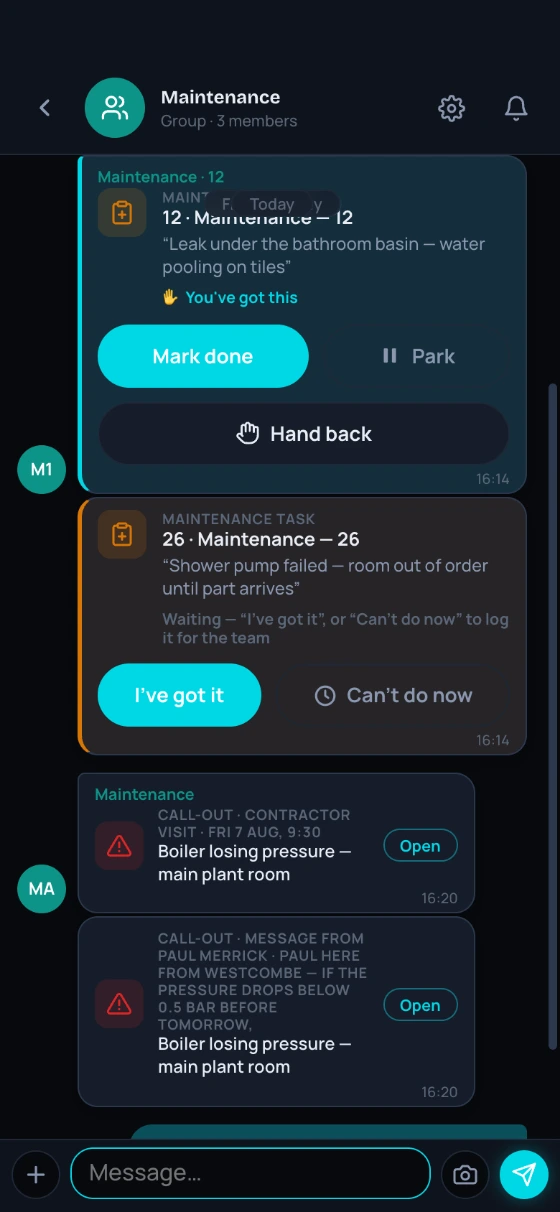
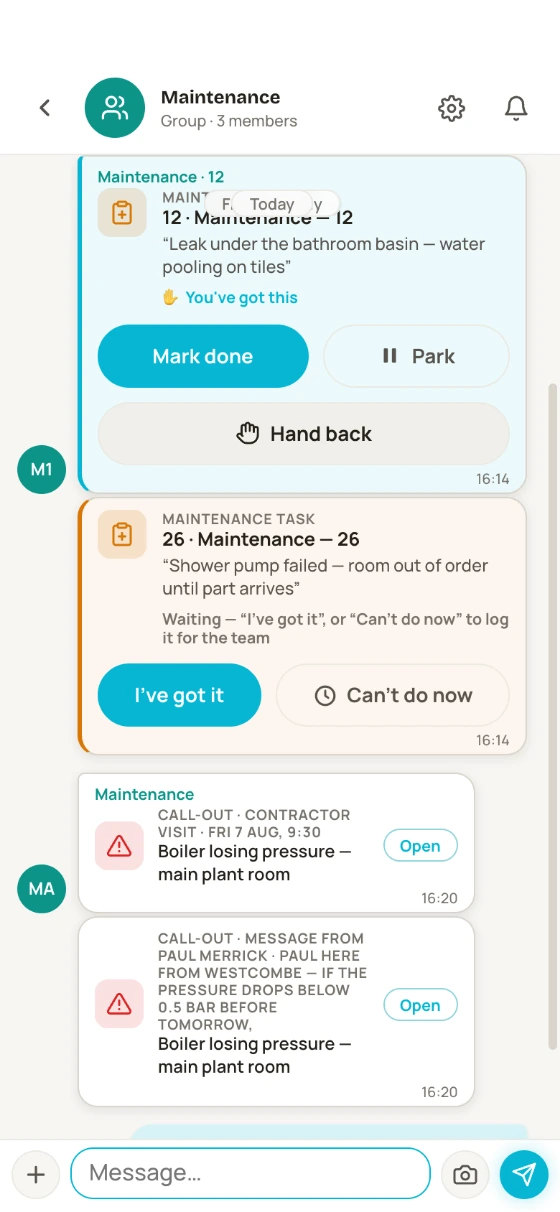
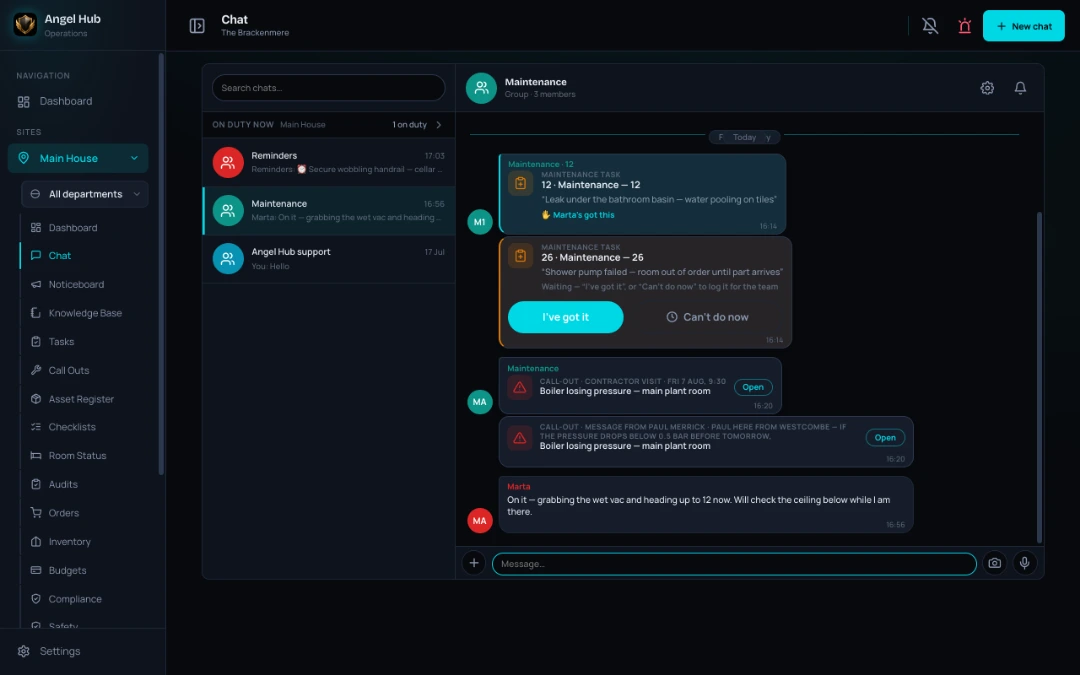
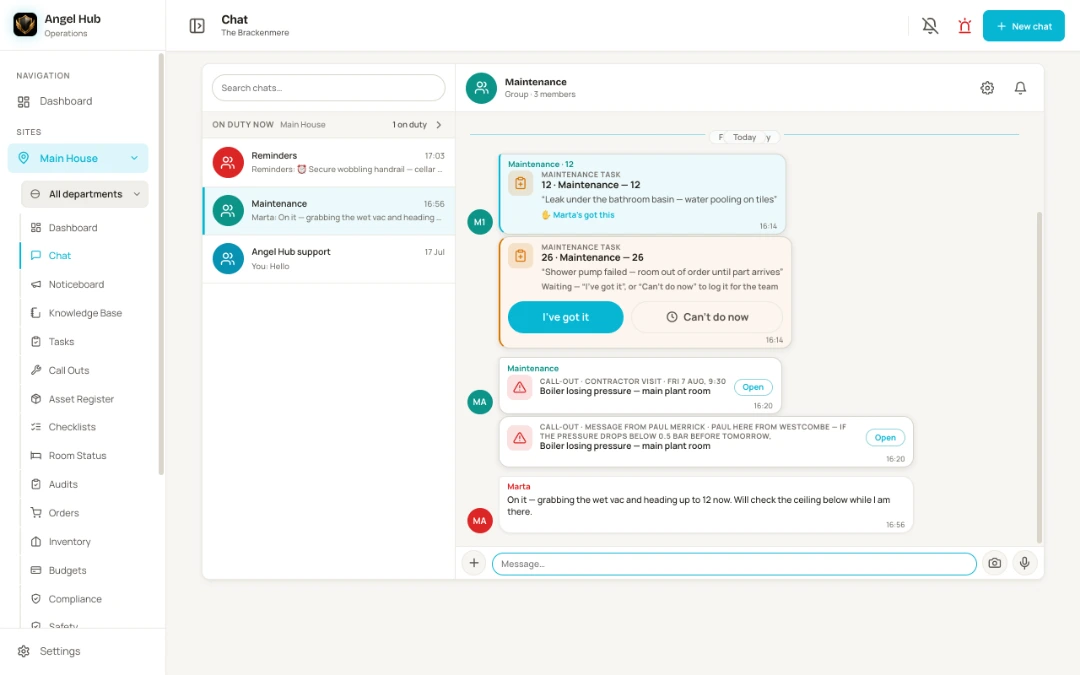
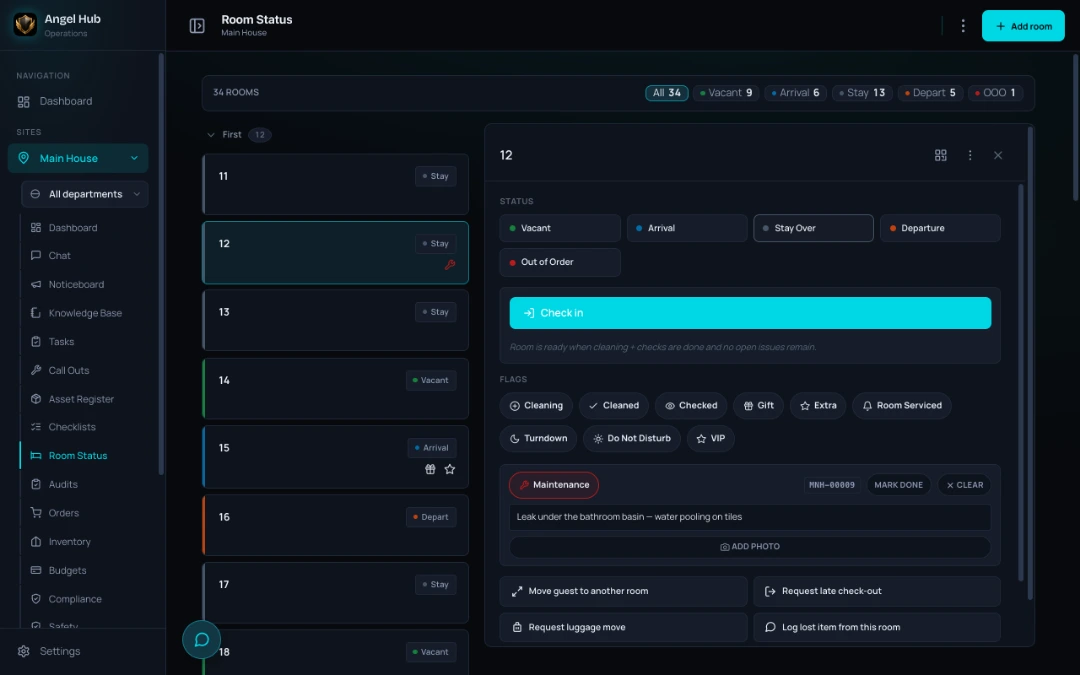
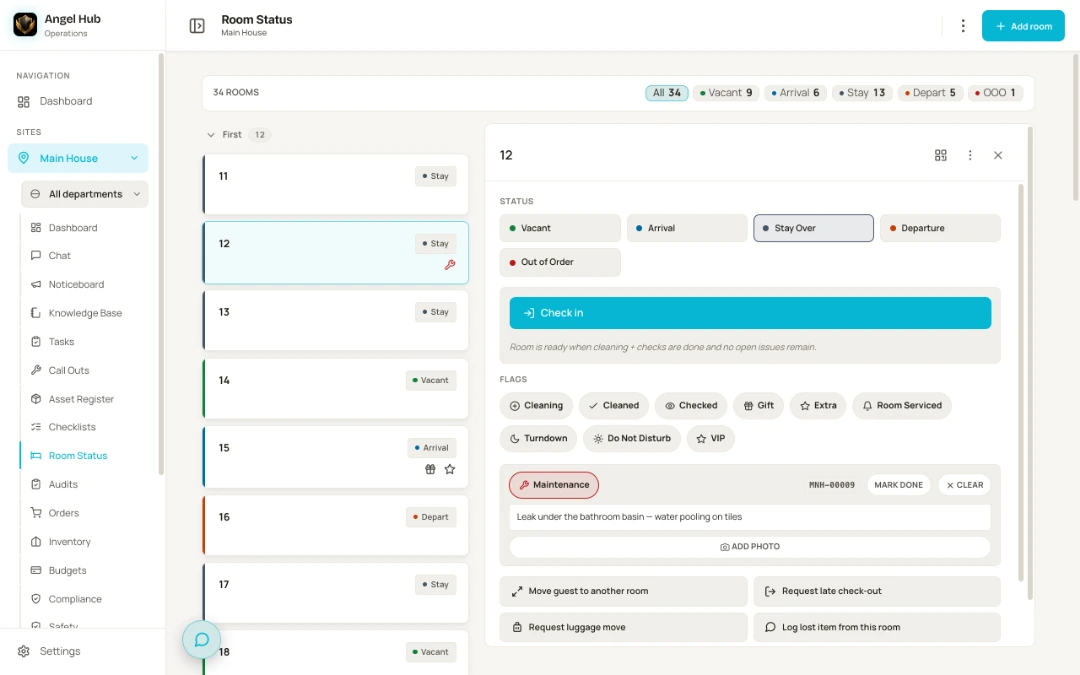
Housekeeping flags the room. That flag is instantly a card in the maintenance chat and a tracked task. Marta claims it — so “someone deal with this” becomes “Marta has it” — and reception, the GM and the housekeeper can all see the stage it’s at.
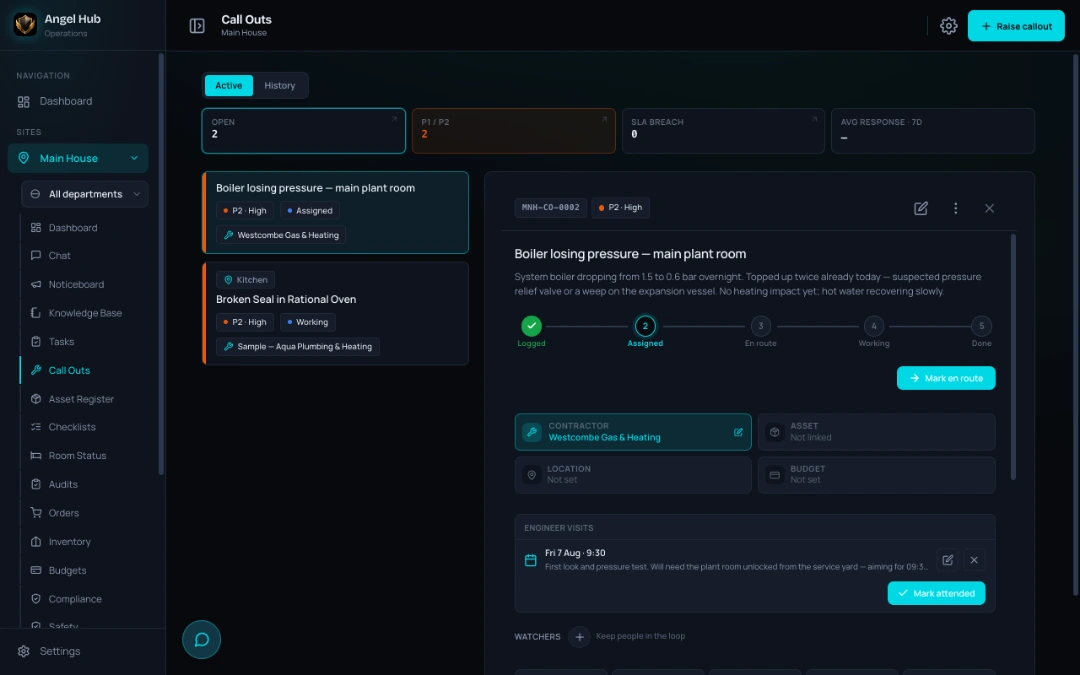
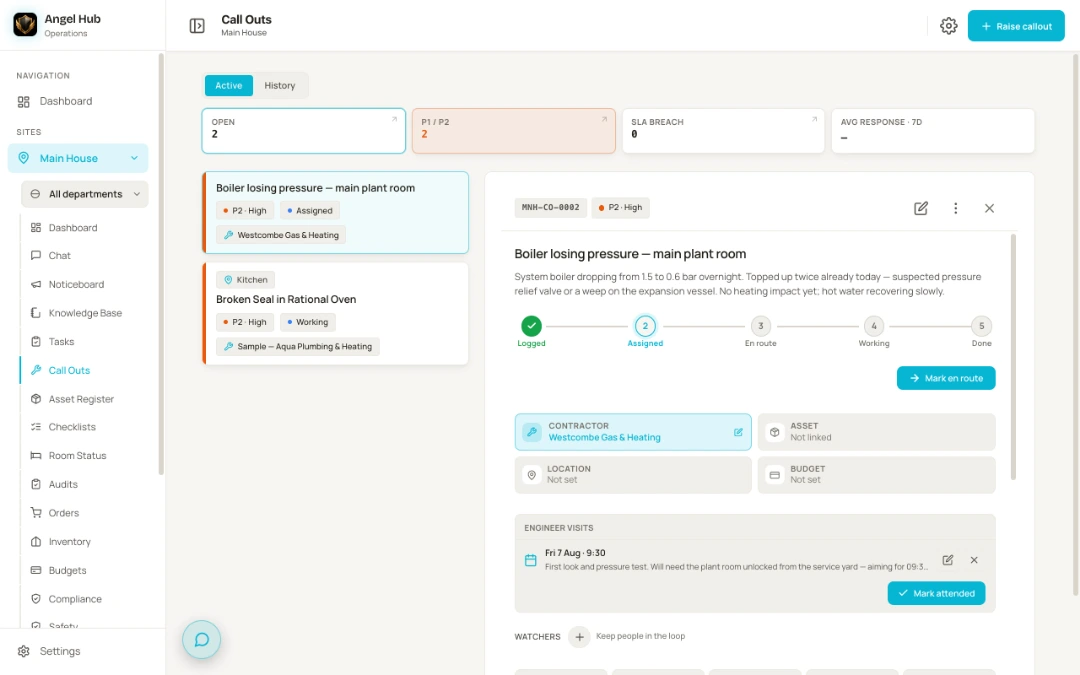
Needs an engineer? The task becomes a call-out in one tap — contractor assigned, booking link sent by WhatsApp or email. The engineer arrives, scans the QR label, and updates the job on the spot — so nobody spends the afternoon asking when he’s coming or what he found.
When it’s fixed, the work and the cost are logged against that room and that asset. Forever.
Handovers explain themselves.
Every task and call-out already shows its stage and the next step, and everyone’s own list knows what’s theirs — so the night team carries on instead of starting again, and nothing walks out the door in someone’s head.
Tomorrow, Statistics shows where the pressure is building — by department and by site — so you strengthen the weak point instead of guessing.
What’s inside
Everything the operation runs on. Genuinely connected.
Other products sell modules. Angel Hub’s modules actually know about each other — that connective tissue is the product.
Communicate & know
The WhatsApp groups retire. Communication moves to where the work is — with the company’s knowledge one tap away.
- Chat — team and one-to-one threads; urgent alerts become claimable job cards; who’s on duty is always in view; any message can become a task.
- Noticeboard — announcements, wins and new starters across the company; must-reads show “confirmed 14 of 20”.
- Knowledge base — everything the business knows, searchable by everyone: how to fix it, where it’s stored, who to order from. New starters find answers without borrowing a colleague’s shift — and what people know stays when they leave. AI can draft a procedure into your house format — it runs on your own Anthropic key, added in Settings on each device, and you can leave it switched off.
- Dashboard — the day at a glance: your tasks, who’s on duty, documents to read, and a calendar of everything due — tasks, call-outs, checklists, audits, services and compliance.
Run the day
The daily engine: who does what, where, by when — visible to the whole team. And not just housekeeping: kitchen, maintenance, front of house and spa each run their own tasks, checklists, audits and knowledge, in the same connected system.
- Tasks — department-aware lists, “my tasks”, one-tap complete; every task can carry its room, asset, project and budget.
- Checklists — photos and instructions on every check, so new starters see exactly what to test without asking, and progress autosaves as staff work; temperature and other readings get your own safe ranges, turn green, amber or red as they’re typed, and build a month-by-month history you can export; a failed check becomes a ready-made task in one tap — asset and department pre-filled — and when that task is done, the check passes itself.
- Rooms — a live status board; a flag becomes a chat card and a task; early check-ins and room-ready events reach the right team.
- Rota — who is working, and when: the week and the day for every department, built as a draft and published when it is right. Staff see only what has been published, the department chat gets the week as a card, and as you build it the app flags what the Working Time Regulations ask for, with the regulation named beside each warning. It is the plan — not clocking in, timesheets or holiday.
- Guest requests & minibar — guests ask from a QR code in the room (no app, no login); minibar use lands on a reception list ready for the bill.
Maintenance & contractors
From “it’s broken” to “fixed, documented and paid for” — with the history to prove it.
- Call-outs — raise one from any task, or straight away; send the contractor a booking link by WhatsApp or email; the engineer scans the QR on site and updates the job, no account needed — you see every stage instantly.
- Asset register — a QR label on every boiler, fridge and lift: scan it for the full history, the instructions and the documents that belong to it — or raise a task that’s already assigned to that asset. Due and overdue servicing flagged before anything slips — the full asset story.
- Contractors — every contractor’s full job history, plus insurance and compliance documents with renewal dates and an at-a-glance health indicator.
- Projects — refurbs and openings as a plan tree with phases, deliveries, budgets and a live red-amber-green roll-up.
Stay compliant
When the EHO, the insurer or head office asks — the answer is already written down.
- Compliance — a renewal clock for certificates and inspections: gas safety, EICR, LOLER and the rest. We also publish what the law actually asks of a hotel in England — the compliance guides.
- Safety — risk assessments, COSHH and safe systems of work with sign-offs; incident reporting with RIDDOR guidance; an export pack ready for an EHO visit.
- Visitors — visitors and contractors sign themselves in from a QR poster at the door, on their own phone, with your assembly point on the screen; reception sees who is on site now, and when the alarm goes that list is the roll call — “12 of 14 accounted for”. It covers people at the door, not your own staff.
- Audits — build your own templates, run them on a phone; sign off and every failed item spawns its corrective task automatically — routed to the department you chose, priority set by severity, with the auditor’s photos and the linked asset attached.
- Training — courses on the phone, assessor sign-offs, refresher tracking, a manager matrix of who’s current, printable certificates.
Money & stock
Spend and stock stop being a month-end surprise — every cost lands where it belongs, as it happens.
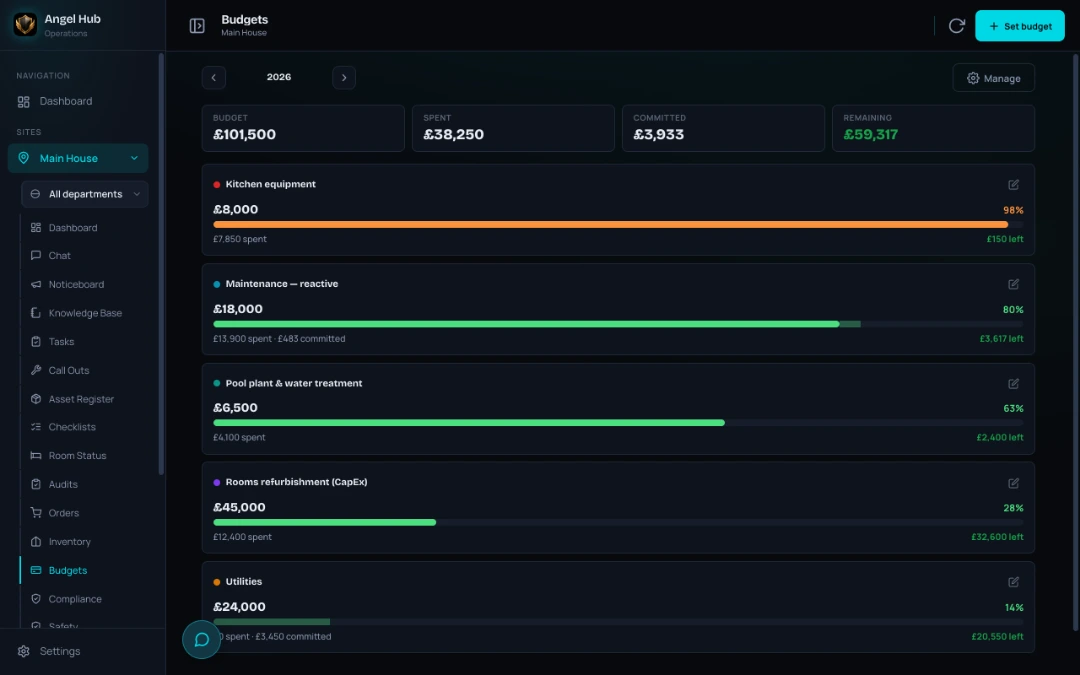
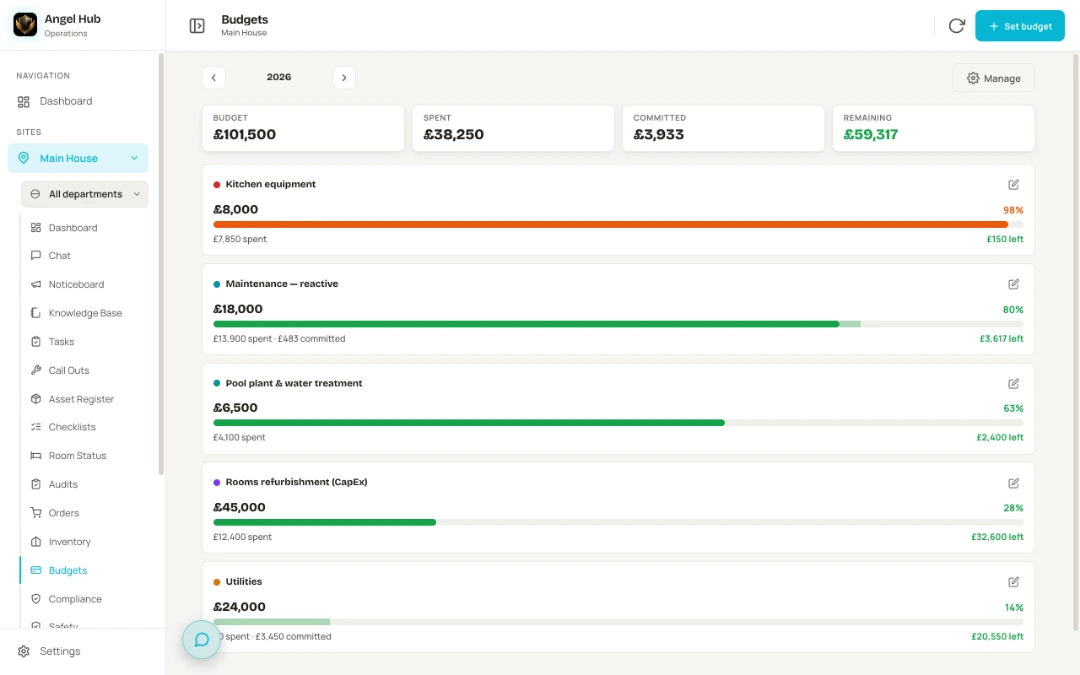
- Budgets — a tree of named pots for the year, with red-amber-green bars and a drill-in. Tag a task, a call-out, an order or a new asset with a pot, and every cost logged on it counts against that pot — spent and committed shown apart.
- Inventory & orders — stock with par levels, monthly counts, suppliers and one-tap order generation.
- Group Store — for groups: one catalogue for the whole estate. A hotel fills a basket and sends it as one order against a budget pot; the store desk works one queue, marks each line — on order, ready to collect, part delivered — and raises the supplier order for what it has to buy in. It moves stock and paperwork between the store and the hotels, not money.
- Energy — meter readings and consumption dashboards.
- Statistics — overdue work by department and site, contractor spend, and the numbers managers actually ask for.
Built on solid foundations
Enterprise-grade underneath, priced for independents — because small hotels deserve the same tools as the big groups.
- Multi-site, multi-department from day one — each department sees its own world; groups see across hotels.
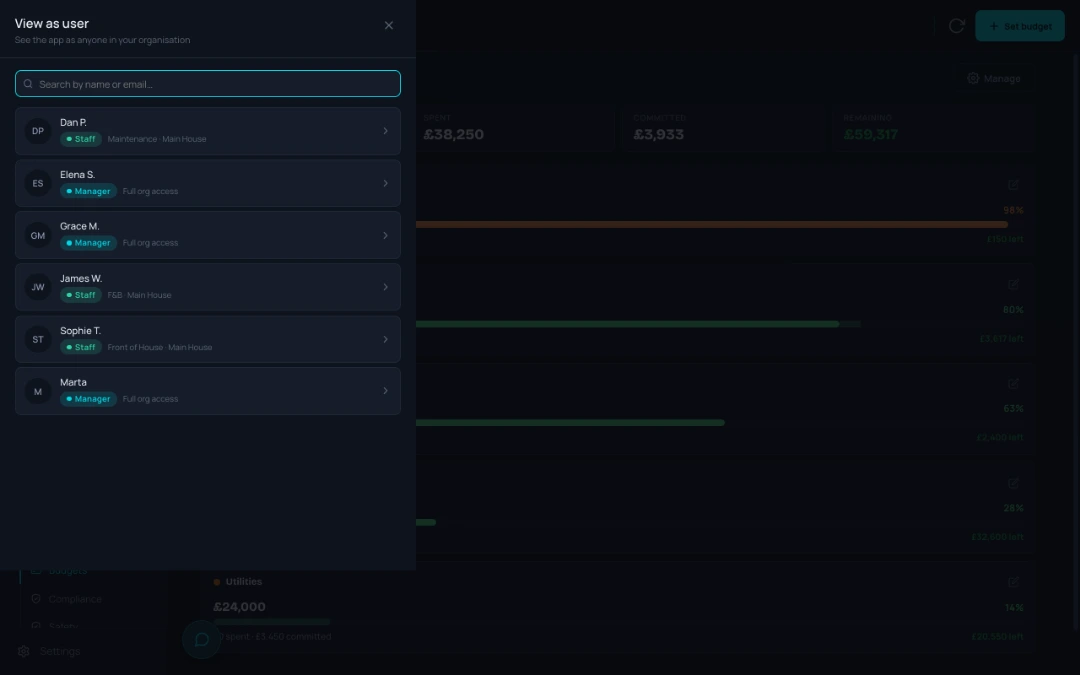
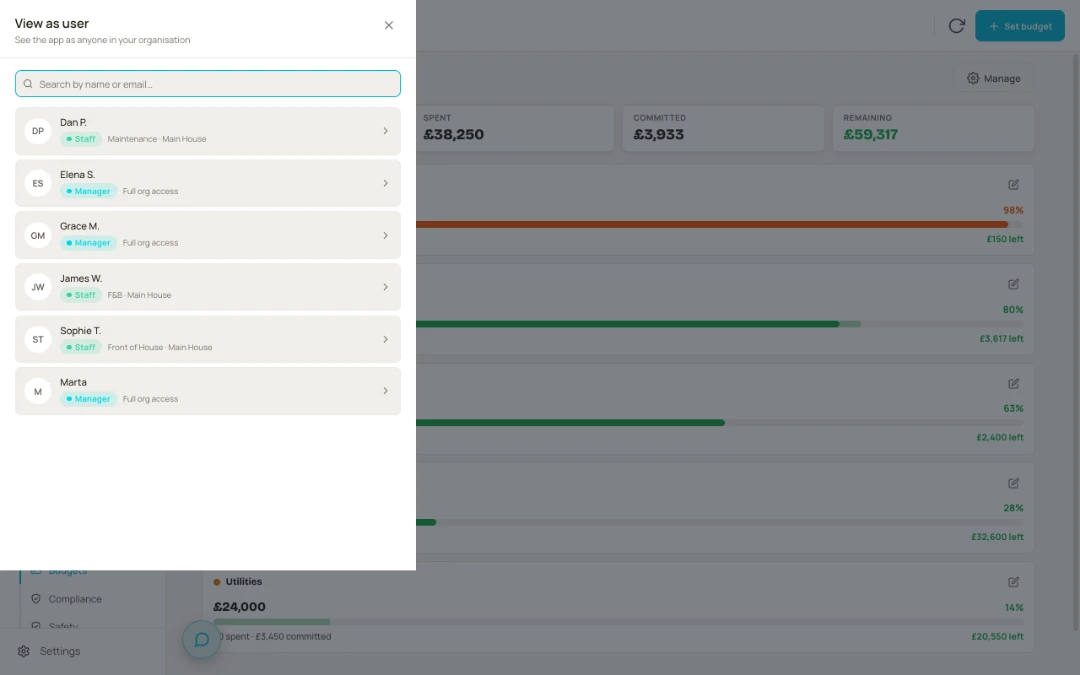
- Roles & permissions you control — and owners can “view as” any staff member to see exactly what their team sees.
- Installs from the browser — works like an app on any phone, no app store, no rollout project; work done without a signal is held on the phone and sent when it returns.
- Outsiders need no accounts — engineers work through a secure link, guests through the in-room QR form. Your data stays isolated to your organisation.
A closer look · the asset register
Every boiler, bed and fridge — with its whole story attached.
A hotel is a building full of expensive kit, and most of its history lives in someone’s head. Angel Hub gives every asset its own page — and a QR label that opens that page for whoever is standing in front of it.
A register you can actually browse.
The register is organised the way your building is. Pick a floor or a room and see everything in it — from the boiler in the plant room to the beds in room 12 — or filter by your own categories. Give each asset a photo and the register can show itself as a photo grid — and interiors categories like sofas, beds and chairs are made for it, so checking a bedroom’s furniture feels like flicking through pictures, not scrolling a spreadsheet.
Behind each photo sits the detail you’ll one day be very glad of — with the manuals and instructions linked from your own knowledge base, so whoever’s standing at the machine can read how it works without ringing anyone.
- Make, model & serial
- Installation date
- Warranty — flagged before it runs out
- Purchase price & budget
- Manuals & certificates
- Photos
Asset register — photo view
Scan the label and stop guessing.
Print a QR label for every asset — sheet labels from the office printer, or a handheld tape printer for the plant room — and stick it on. From then on, the label answers the questions. Your team scans it to raise a call-out, add a task, log a service or open the instructions — everything pre-filled for that exact asset, nothing retyped.
When an engineer arrives, they scan the same label and type their name and company — no account, no app, no password. They see exactly what they’re standing in front of: the asset’s details, when it was last serviced and what’s due, and the hotel’s open jobs on it with the fault photos attached. Nobody has to find the manager who logged it.
And when they file their visit report — work done, before-and-after photos, costs, outcome — everyone watching that job gets the update on their phone straight away. Nothing is lost between the plant room and the office.
The engineer’s scan
The history that settles the argument.
Every call-out, task, logged service, note, photo and document lands on the asset’s own timeline — so “how many times has this thing broken?” takes seconds to answer, not an argument to have.
The register also adds up what each asset has really cost — call-out costs, task costs, anything you add by hand — year by year. Tell it what a new one costs, and as repair spend climbs towards the price of buying new, the asset says so itself: replace recommended. The third repair bill for the same fridge stops being a debate.
Servicing has its own clock. Every asset carries its own service schedules, due and overdue are flagged across the register and on the scan menu, and a due service becomes a maintenance task in one tap. When it’s your gas engineer’s annual round, send them a secure link by WhatsApp or email — no account — and they see their own worklist, overdue first, and log each service with its certificate, photos and cost straight onto the record. The link expires by itself, and you can switch it off any time.
History & running cost
Getting started
No IT project. Honestly.
See it on your phone
Book a demo and bring one real problem — a repeated leak, a messy handover, an audit you dread. We walk through how Angel Hub handles it, on a phone, in your hands.
We set it up together
Your sites, departments and team go in during a call — with ready-made roles to hand out and 27 service schedules, each with its legal reference, added by one button. No data migration project, no consultants.
Your team starts the same day
Staff install it from the browser — no app store, no laptops, no training day. Week one is yours: the first checklist, the first few assets, one routine at a time. Everything else can wait until you want it.
If your team can use WhatsApp, they can use Angel Hub. That’s the design bar: phone-first, fast and calm — a tool staff open because it helps, not because they’re chased. Want the shape of it before the call? Read how a hotel runs on Angel Hub.
Pricing
One price per hotel. Everything included.
Small
£149 / hotel / month + VAT
Up to 30 rooms. For smaller properties and compact teams.
Standard
£399 / hotel / month + VAT
31 to 90 rooms. For the typical independent hotel.
Large
£749 / hotel / month + VAT
91 rooms and over. For big properties and busy multi-department operations.
Which tier? Count your rooms — that is all. No per-room formulas, no counting users. On the line between two tiers, or an unusual operation? Talk to us.
Pay yearly, get two months free — annual is ten times the monthly price.
All prices exclude VAT, which is added at the rate in force.
Running a group? 2–10 properties with one view across sites — talk to us.
Founder photo
Who’s behind it
Built on hotel shifts, not in a software office.
Angel Hub was built by Radek, who spent years running hospitality operations in one of the UK’s most admired independent hotel groups. He built the tool he needed on shift and couldn’t buy: one place where the whole operation lives, that staff actually want to open.
Every screen was shaped by real handovers, real EHO visits and real Saturday changeovers — not user-story workshops. The bar it’s built to: so good your team can’t imagine working without it.
The goal is simple: give people their time back — less chasing, less paperwork, more of the job they’re actually there to do.
10% of Angel Hub’s profits go to community projects — and we show you exactly where every pound went.
Honest answers
The questions GMs actually ask.
Will it run on our phones?
Do you charge per user?
Do engineers and guests need accounts?
Is it a PMS or booking system?
Whose data is it?
How long does it take to get started?
Book a demo
See it on your phone.
Bring one real problem from your hotel — a repeated leak, a messy handover, an audit you dread — and we’ll show you what it looks like when everything is connected.
Or write to us: info@angelhub.co.uk